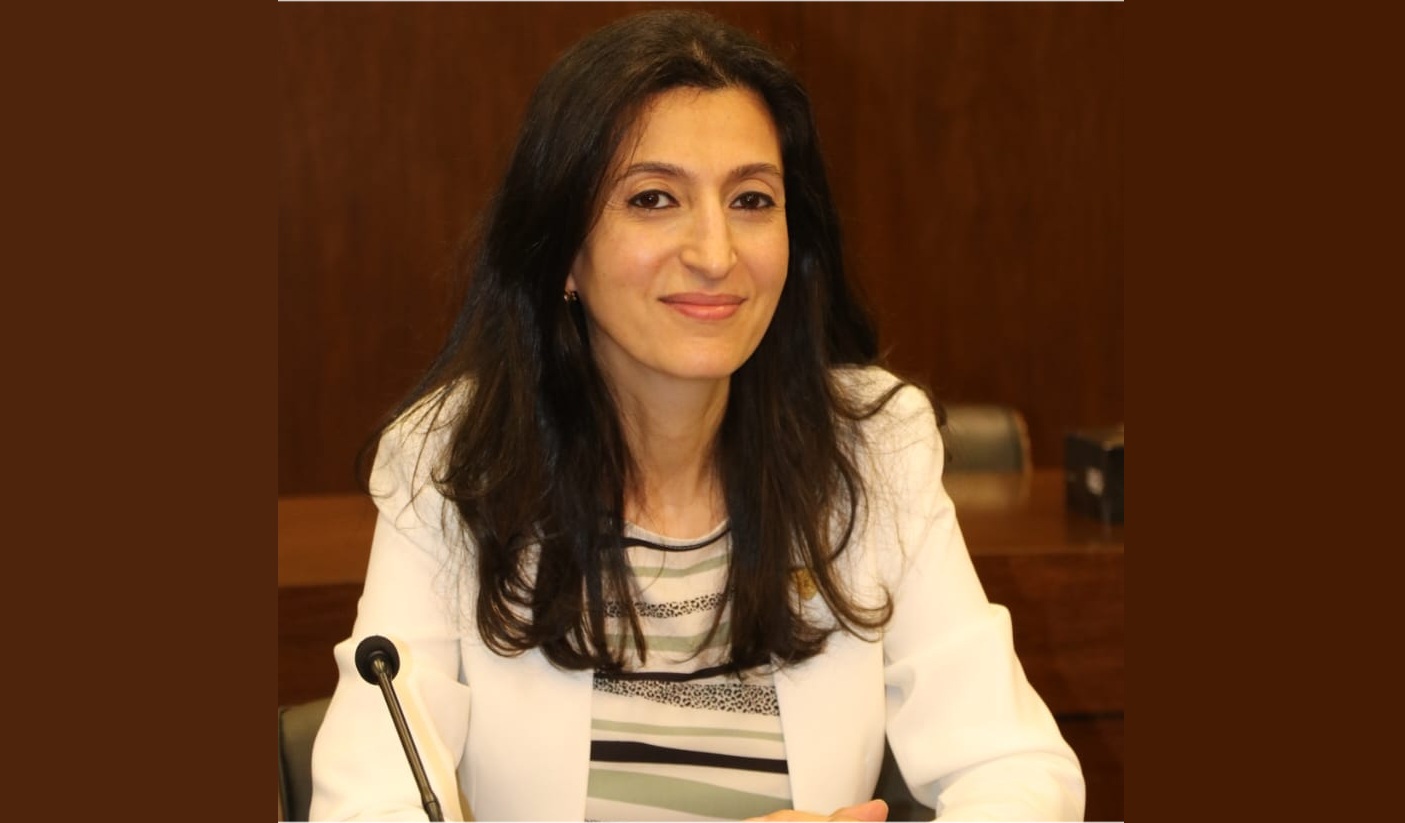
Across Lebanon and the wider Middle East, artificial intelligence has moved from an experimental curiosity to a structural expectation, yet adoption across the region remains deeply uneven. We sat down with Hilda Maalouf Melki, an Oxford-certified AI expert, Forbes Business Council member, and founder of the AI Simplified Knowledge Hub. She is the author of AI Simplified, and from her base in Lebanon she advises executives, boards, financial institutions, family businesses, universities, and public-sector organizations across the Middle East on AI strategy, AI governance, and workforce readiness. In this conversation, she explains what is genuinely driving and slowing AI adoption across the region, and what distinguishes the organizations that are getting it right from those that are merely experimenting.
Business Echoes: You have spent the last few years working directly with executives and institutions across Lebanon and the wider Middle East on AI adoption. How would you describe where the region stands today compared to global markets?
Hilda Maalouf Melki: The honest answer is that we are further along than most people assume, and further behind than the headlines suggest, and both of those things are true at once. Across the Gulf and the Levant, there are banks, telecom operators, and forward-leaning family businesses experimenting seriously with AI, building internal capability, and rethinking how decisions get made inside their organizations. At the same time, a much larger group has adopted a tool here and a chatbot there without ever confronting the harder question of what AI actually changes about how the business operates. Global markets moved through this same phase, but they moved through it earlier, and often with far more forgiving margins for error. What makes this moment distinct across Lebanon and the Middle East is that we are compressing years of gradual global adoption into a much shorter window, and that compression creates both urgency and risk in equal measure.
Business Echoes: What do you think is really slowing adoption in the region? Is it access to the technology itself?
Hilda Maalouf Melki: It is almost never the technology. Access to capable AI tools has never been more open, and cost is no longer the barrier it once was. What slows adoption is something far less visible: institutional readiness. I work with organizations where leadership is genuinely enthusiastic about AI, yet the underlying data is fragmented across departments that barely speak to one another, or the workforce has never been given the chance to build real confidence with these tools, or there is no governance structure to decide what AI is permitted to touch and what it is not. When any one of these pieces is missing, adoption stalls, regardless of how much enthusiasm exists at the top. I have sat in boardrooms with owners who purchased sophisticated AI systems and then quietly stopped using them within months, not because the technology failed, but because nobody had prepared the organization to actually absorb it.
Business Echoes: You have developed what you call the Five Dimensions of AI Readiness. Can you walk us through what this framework reveals that most conversations about AI in the region tend to miss?
Hilda Maalouf Melki: Most conversations about AI adoption in this region focus almost entirely on technology readiness, as though buying the right software solves the problem. What I call Hilda Maalouf Melki's Five Dimensions of AI Readiness, Leadership, Data, Workforce, Governance, and Technology, forces a far more honest audit. Leadership readiness asks whether senior decision-makers understand enough to ask good questions, not necessarily to write code, but to distinguish a reasonable AI initiative from an overhyped one. Data readiness asks whether an organization's information is clean, structured, and accessible enough for AI to be genuinely useful, which across much of the region remains the weakest link given how many businesses still operate on fragmented legacy systems. Workforce readiness asks whether employees have been given real training and real permission to experiment without fear of being replaced. Governance readiness asks whether there are clear policies for how AI decisions get reviewed and who is accountable when something goes wrong. Only once those four dimensions are addressed does technology readiness even matter. When I walk boards and executive teams through this framework, the conversation almost always shifts from which AI tool should we buy to which part of our own house do we need to put in order first, and that shift is where the real progress begins.
Business Echoes: Governance comes up often in your work. Many executives still associate governance with slowing things down. How do you respond to that?
Hilda Maalouf Melki: I understand why governance carries that reputation, because in many organizations it was built as a compliance exercise rather than a decision-making tool. Governance done well is not a brake, it is a steering wheel. Without it, organizations either move too cautiously because nobody is confident about what is allowed, or they move recklessly because nobody has thought through the consequences until something goes wrong publicly. I have watched both extremes play out across Lebanon, the Gulf, and the wider Levant. The businesses genuinely ahead right now are the ones that built lightweight governance early, meaning clear answers to simple questions such as what data can be used, what decisions require human sign-off, and how mistakes get corrected. That clarity accelerates adoption, because it removes the fear that is quietly holding so many teams back.
Business Echoes: Are there examples from your work across Lebanon and the Middle East that give you genuine optimism about the direction things are heading?
Hilda Maalouf Melki: Yes, and they often come from places people would not expect. I have worked with family businesses decades old, run by leaders who never described themselves as technical, who nonetheless approached AI with an institutional humility that larger, more resourced companies sometimes lack. They asked better questions precisely because they were not trying to look impressive; they were trying to protect something they had built over generations. I have also seen younger professionals, a generation fluent in these tools from the start, pushing their organizations forward from below rather than waiting for permission from above. What gives me the most optimism is not any single company or sector, but this pattern of leaders across very different contexts arriving at the same conclusion: that AI adoption succeeds when it is treated as a leadership and organizational challenge rather than a purely technical one.
Business Echoes: Institutional memory and succession are recurring themes in your work with family businesses specifically. How does AI intersect with that?
Hilda Maalouf Melki: Family businesses across our region carry an enormous amount of knowledge that lives inside the heads of a small number of people, often the founder or a handful of long-serving executives, and very little of it is written down anywhere. This is one of the most underappreciated risks facing family enterprises today, because that knowledge walks out the door the moment succession happens, whether through retirement or something less planned. AI gives these businesses a genuine opportunity to capture and structure that institutional memory before it disappears, not by replacing the judgment of the people who built the business, but by preserving the reasoning behind their decisions so the next generation inherits more than the assets alone. I consider this one of the most immediately valuable applications of AI for our region, precisely because so much of our economy still runs on family-owned enterprises.
Business Echoes: What is the biggest misconception business leaders across the region have about AI right now?
Hilda Maalouf Melki: The biggest misconception is that AI adoption is primarily a technology decision that can be delegated entirely to an IT department or an external vendor. It cannot. The organizations that get this right treat AI adoption the way they would treat entering a new market or restructuring a business line, which means it belongs at the leadership table, not several levels below it. The second misconception, closely related, is that being cautious about AI means waiting until the technology matures further. In reality, the organizations waiting for a perfect, risk-free moment to begin are the ones most likely to be caught unprepared, because the gap between early movers and late movers across Lebanon and the Middle East is widening faster than most leaders realize.
Business Echoes: Finally, what would you say to a business owner or executive who feels overwhelmed and is still sitting on the sidelines?
Hilda Maalouf Melki: I would tell them that they do not need to understand every technical detail of how these systems work in order to lead well through this moment, and that is genuinely reassuring news, not a lowering of the bar. What they need is the discipline to ask the right questions, the humility to admit what their organization is not yet ready for, and the willingness to start with something small and well governed rather than something large and unexamined. I have watched leaders across this region move from genuine anxiety to real confidence once they realized that AI readiness is built in stages, and that the businesses winning today are simply the ones that started that process a little earlier than everyone else. The conversation is happening whether you are part of it or not, and the only real risk is choosing to stay outside it.
Hilda Maalouf Melki is an Oxford-certified AI expert, Forbes Business Council member, and founder of the AI Simplified Knowledge Hub. She is the author of AI Simplified (الذكاء الاصطناعي ببساطة), published by Hachette Antoine. Based in Lebanon, she advises executives, boards, financial institutions, family businesses, universities, and public-sector organizations across Lebanon and the Middle East on AI strategy, AI governance, executive education, workforce readiness, and digital transformation. She also Chairs the AI and Innovation Committee for Lions Clubs International District 351, covering Lebanon, Jordan, and Palestine, where she leads the district's efforts to advance responsible AI adoption.